
Illinois Driver’s Manual in Spanish: A Comprehensive Guide
Navigating Illinois roads requires understanding its driving rules, and the Spanish manual is key. Preparation, fulfilling requirements, and mastering the exam are crucial for success.
Understanding the Illinois Driver’s Manual (Manual de Manejo de Illinois)

The Illinois Driver’s Manual, available in Spanish, is your primary resource for obtaining a driver’s license. It details all traffic laws, road sign meanings, and safe driving practices specific to Illinois.
Successfully navigating the licensing process hinges on a thorough understanding of this document.
It’s designed to prepare you for both the written knowledge test and the practical driving exam.
The manual covers essential topics like right-of-way rules, speed limits, and the consequences of driving under the influence.
Feeling prepared and confident is vital, and this manual is your first step towards achieving that.
Availability and Accessing the Spanish Version
The Illinois Secretary of State provides convenient access to the Manual de Manejo de Illinois. You can easily download a digital copy directly from their official website, ensuring you have the most up-to-date information. This online access allows for studying anytime, anywhere.
For those preferring a physical copy, the manual is available at various Driver Services facilities throughout the state. These locations offer a tangible resource for learners. Obtaining the manual is the crucial first step towards preparing for your Illinois driving exams and achieving licensure.

Online Access to the Manual
Accessing the Spanish version of the Illinois Driver’s Manual online is remarkably straightforward. The Illinois Secretary of State’s website hosts a downloadable PDF version, readily available for free. This digital format allows for convenient study on computers, tablets, or smartphones.
Simply navigate to the official website and search for “Manual de Manejo.” Downloading the manual ensures you always have the latest regulations and guidelines at your fingertips. This online resource is an excellent starting point for anyone preparing to take the Illinois driving exam, offering a flexible and accessible learning experience.
Physical Copy Locations
For those preferring a tangible resource, physical copies of the Illinois Driver’s Manual in Spanish are available at various locations throughout the state. Driver Services facilities are primary distribution points, offering the manual free of charge to anyone preparing for the driving exam.
Additionally, many public libraries across Illinois stock the Spanish version. Checking with your local library is a convenient way to obtain a copy. These physical locations provide an alternative for individuals who prefer reading a printed document or lack consistent internet access, ensuring accessibility for all prospective drivers.
Eligibility Requirements for an Illinois Driver’s License
Securing an Illinois driver’s license involves meeting specific criteria outlined in the manual. Residency is paramount; applicants must prove they live in Illinois. Age dictates the licensing path, with a Graduated Driver Licensing (GDL) system for younger drivers, imposing restrictions before full licensure.
Valid identification is essential, requiring documentation confirming identity and legal presence. The manual details acceptable forms. Understanding these prerequisites, as detailed within the Manual de Manejo de Illinois, is the first step towards legally operating a vehicle.
Age Restrictions and Graduated Driver Licensing (GDL)
Illinois implements a Graduated Driver Licensing (GDL) system, detailed in the manual, based on age. Drivers under 18 face restrictions, starting with a learner’s permit requiring supervised driving hours. Progression to an intermediate license brings limitations on nighttime driving and passenger numbers.
Full licensure is granted at 18, contingent upon a clean driving record. The Manual de Manejo de Illinois clearly outlines each stage, emphasizing safety and gradual exposure to driving responsibilities. Understanding these age-related rules is vital for young drivers and their parents.
Residency Requirements and Proof of Address
To obtain an Illinois driver’s license, you must prove residency within the state. The Manual de Manejo de Illinois specifies acceptable documents, including utility bills, lease agreements, bank statements, or official mail. Two different documents verifying your Illinois address are generally required.
These documents must be current and display your name and address. Temporary or post office box addresses are typically not accepted. Establishing residency is a fundamental step, ensuring only eligible individuals receive Illinois driving privileges.
Required Identification Documents
The Manual de Manejo de Illinois details acceptable identification for licensing. You’ll need to present documents verifying your identity, date of birth, and legal presence in the United States. Common examples include a valid U.S. birth certificate, a valid passport, or a Permanent Resident Card.
Social Security number verification is also essential. Ensure all documents are original or certified copies; photocopies are generally not accepted. Proper identification is a critical component of the application process, ensuring driver legitimacy.
Preparing for the Illinois Driving Exam
Thorough preparation, guided by the Manual de Manejo de Illinois, is vital for exam success. Overcome pre-exam nerves by utilizing available resources and practicing diligently. The manual provides a comprehensive overview of the written knowledge test’s content, covering traffic laws, road signs, and safe driving practices.
Focus on understanding, not just memorizing, the rules of the road. Numerous free practice tests are available online to assess your readiness and identify areas needing improvement. A confident approach significantly increases your chances of passing.
Understanding the Written Knowledge Test (Examen Teórico)
The Illinois written knowledge test, or Examen Teórico, assesses your understanding of traffic laws and safe driving principles. The Manual de Manejo de Illinois is your primary study resource, covering everything from speed limits and right-of-way rules to proper signaling and hazard perception.
Expect questions on road signs, alcohol-related driving laws, and defensive driving techniques. Familiarize yourself with the manual’s illustrations and explanations. A strong grasp of these concepts is essential for achieving a passing score and progressing towards your driver’s license.
Practice Tests and Study Resources (Recursos de Estudio)
Supplementing the Manual de Manejo de Illinois with practice tests is vital for exam success. Numerous free online resources offer simulated tests mirroring the actual Examen Teórico, helping you identify knowledge gaps and build confidence.
These resources often provide explanations for correct and incorrect answers, reinforcing your understanding of Illinois traffic laws. Utilize these tools to repeatedly assess your preparedness. Remember, consistent practice and focused study, alongside the manual, significantly increase your chances of passing the written exam.

Common Mistakes to Avoid on the Written Test
Many candidates fail the Illinois written exam due to preventable errors. Rushing through questions is a frequent mistake; carefully read each one and all answer choices before selecting. Misunderstanding traffic sign meanings, especially regulatory signs, is another common pitfall.

Failing to fully grasp right-of-way rules and speed limit regulations also leads to errors. Thoroughly review these sections in the Manual de Manejo de Illinois. Finally, overlooking key words like “always” or “never” can alter a question’s meaning, so pay close attention to detail.
The Illinois Driving Test: What to Expect (El Examen Práctico)
The Illinois practical driving exam assesses your ability to safely operate a vehicle. Expect evaluation of fundamental maneuvers like proper lane changes, smooth turns, and controlled stops. Examiners will observe your adherence to traffic laws, including speed limits and right-of-way rules.
Vehicle condition is crucial; ensure all lights function and the vehicle is legally registered. Nervousness is common, but maintaining composure and demonstrating confident, safe driving are key to passing. Review the Manual de Manejo de Illinois thoroughly beforehand.
Vehicle Requirements for the Driving Test
To successfully complete the Illinois driving exam, your vehicle must meet specific requirements. It needs to be currently registered, properly insured, and in safe operating condition. All lights – headlights, brake lights, turn signals – must function correctly. The examiner will verify the vehicle’s safety features, including working seatbelts for all occupants.
The vehicle must have a valid inspection sticker if required. Any pre-existing damage impacting safety could lead to disqualification. Refer to the Manual de Manejo de Illinois for a complete checklist before your scheduled test.
Common Maneuvers Evaluated During the Test
The Illinois driving test assesses your ability to safely operate a vehicle in various scenarios. Expect to demonstrate proficiency in basic maneuvers like smooth starts and stops, lane changes with proper signaling, and controlled turns. Parallel parking is a standard component, requiring precision and control.
Examiners also evaluate your ability to navigate intersections, yield right-of-way, and observe traffic laws. Maintaining a safe following distance and demonstrating awareness of surroundings are crucial. Review the Manual de Manejo de Illinois for detailed guidance on these skills.

Grading System and Passing Score
The Illinois driving exam utilizes a point-based grading system to objectively assess your performance. Each error committed during the test results in a deduction of points. Critical errors, such as unsafe actions, lead to immediate failure, regardless of accumulated points.
To pass the Illinois driving test, you must achieve a minimum passing score, typically around 84 points out of 100. Familiarize yourself with the Manual de Manejo de Illinois to understand common errors and avoid point deductions. A thorough understanding of the evaluation criteria is essential for success.
Traffic Laws and Regulations in Illinois (Leyes de Tráfico)
Illinois roadways operate under a comprehensive set of traffic laws designed to ensure safety for all users. Understanding these regulations, detailed within the Manual de Manejo de Illinois, is paramount for responsible driving. Key areas include posted speed limits, varying by zone, and strict adherence to right-of-way rules at intersections.
Furthermore, Illinois enforces zero-tolerance laws regarding driving under the influence of alcohol or drugs. Familiarizing yourself with these regulations, and practicing safe driving habits, is crucial for avoiding violations and maintaining a clean driving record.
Speed Limits and Zones
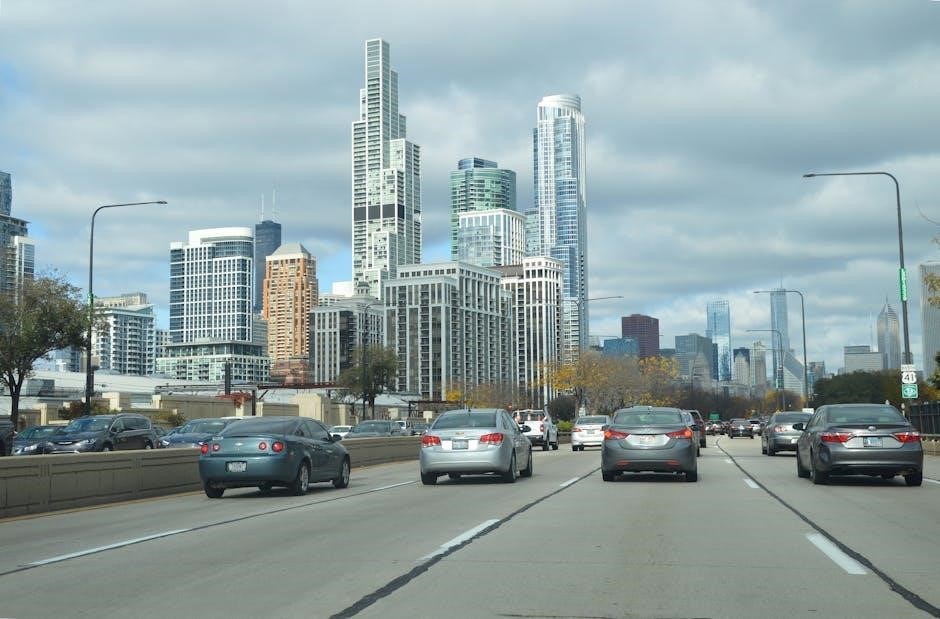
Illinois establishes varying speed limits based on road type and location, detailed in the Manual de Manejo de Illinois. Typically, rural interstates allow for 70 mph, while urban interstates are capped at 55 mph. On most state highways, the limit is 55 mph, and in residential or business districts, it drops to 30 mph or even 20 mph in school zones.
Drivers must always observe posted speed limit signs, as these supersede general limits. Reduced speed limits are often in effect during inclement weather or construction zones, demanding increased caution.
Right-of-Way Rules
Understanding right-of-way is vital for safe driving in Illinois, as explained in the Manual de Manejo de Illinois. Generally, yield to pedestrians and vehicles already in the intersection. When approaching a four-way stop, the first vehicle to arrive has the right-of-way. If arriving simultaneously, the vehicle on the right proceeds first.
When merging onto a highway, yield to traffic already on the roadway. Always exercise caution at intersections, even with a green light, scanning for potential hazards and respecting the flow of traffic.
Rules Regarding Alcohol and Driving (Conducir Bajo los Efectos del Alcohol)
Illinois has strict laws against driving under the influence (DUI), detailed within the Manual de Manejo de Illinois. It’s illegal to operate a vehicle with a Blood Alcohol Concentration (BAC) of .08% or higher. Penalties for DUI are severe, including fines, license suspension, and even jail time.
The manual emphasizes zero tolerance for drivers under 21; any detectable alcohol level can result in legal consequences. Never drink and drive – plan ahead with a designated driver or alternative transportation.
Understanding Illinois Road Signs (Señales de Tráfico)
The Manual de Manejo de Illinois dedicates significant space to deciphering road signs, vital for safe driving. Signs fall into three main categories: regulatory, warning, and guide signs. Regulatory signs dictate what you must or must not do – speed limits, stop signs, etc.
Warning signs alert you to potential hazards ahead, like curves or pedestrian crossings. Guide signs provide directional information and identify routes. Recognizing these signs quickly is crucial for navigating Illinois roadways safely and legally.
Regulatory Signs
Regulatory signs, as detailed in the Manual de Manejo de Illinois, inform drivers of laws and regulations. These signs are legally binding, and ignoring them can result in fines or accidents. Common examples include speed limit signs, stop signs, yield signs, and do-not-enter signs.
Understanding the shape and color of these signs is essential; red often indicates prohibition, while white regulates traffic. The manual emphasizes strict adherence to regulatory signs for maintaining order and safety on Illinois roads.
Warning Signs
The Manual de Manejo de Illinois highlights warning signs as crucial for anticipating potential hazards. Typically yellow and diamond-shaped, these signs alert drivers to conditions requiring caution, such as curves, intersections, pedestrian crossings, or upcoming road work.
They don’t prohibit action but advise drivers to reduce speed or be prepared to stop. Recognizing these signs proactively allows for safer driving decisions. The manual stresses that ignoring warning signs significantly increases the risk of collisions, emphasizing vigilance.
Guide Signs
The Illinois driver’s manual, in Spanish, details guide signs as providing helpful information for navigation. These signs, often rectangular and utilizing various colors, offer directions to destinations, identify points of interest, and indicate available services like gas stations, hospitals, or lodging.
Guide signs assist drivers in making informed decisions about routes and locating essential amenities. They are designed to complement regulatory and warning signs, contributing to a smoother and safer driving experience. Understanding these signs is vital for efficient travel.
Safe Driving Practices in Illinois
The Illinois driver’s manual, even in Spanish, emphasizes prioritizing safety on the roadways. This includes employing defensive driving techniques – anticipating potential hazards and reacting proactively. Illinois law strictly prohibits distracted driving, meaning no texting or handheld device use while operating a vehicle.
Furthermore, drivers must demonstrate respect and caution when sharing the road with pedestrians and cyclists, yielding the right-of-way when necessary. Adhering to these practices significantly reduces the risk of accidents and ensures a safer environment for everyone.
Defensive Driving Techniques
The Manual de Manejo de Illinois strongly advocates for defensive driving. This proactive approach involves constantly scanning the road, anticipating potential hazards, and maintaining a safe following distance. Be aware of other drivers’ behaviors and potential blind spots.
Always have an “out” – a clear path to maneuver if an emergency arises. Regularly check mirrors, signal intentions clearly, and adjust speed to conditions. Defensive driving isn’t about avoiding accidents; it’s about minimizing their impact when they occur, protecting yourself and others.
Distracted Driving Laws
Illinois law strictly prohibits handheld cell phone use while driving. The Manual de Manejo de Illinois emphasizes that any activity diverting attention from driving is dangerous. This includes texting, using apps, and even hands-free devices if they compromise focus.
Penalties for distracted driving violations can include fines and points on your driving record. Prioritize safe driving by silencing devices, programming navigation before starting, and avoiding any non-driving tasks while behind the wheel. Focus solely on the road and surrounding traffic.
Sharing the Road with Pedestrians and Cyclists
The Manual de Manejo de Illinois stresses the importance of vigilance around pedestrians and cyclists. Drivers must yield the right-of-way at crosswalks, marked or unmarked, and exercise caution in areas with increased pedestrian or bicycle traffic. Maintain a safe following distance and be prepared to stop.
Illinois law requires drivers to give cyclists at least three feet of clearance when passing. Always check mirrors and blind spots before changing lanes near cyclists. Respect their right to the road and prioritize their safety, fostering a shared roadway environment.