
Fossil Watch Instructions Manual: A Comprehensive Guide
Welcome! This manual details operation, features, troubleshooting, and care for your Fossil timepiece – from quartz and mechanical to advanced smartwatch models;
Understanding Your Fossil Watch
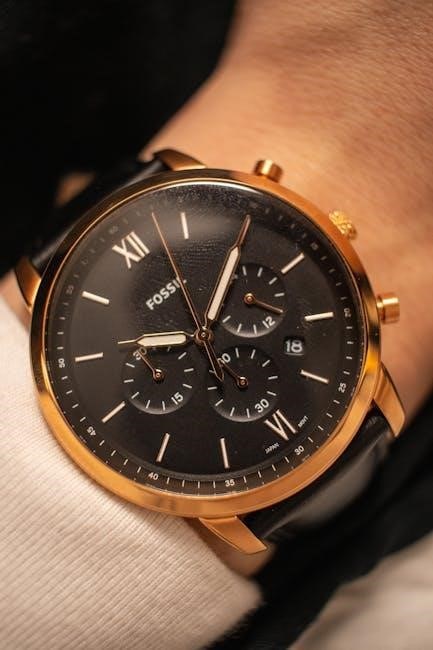
Fossil offers a diverse range of timepieces, each with unique characteristics. Before diving into operation, identifying your watch type is crucial. Quartz watches are battery-powered, known for accuracy and reliability. Mechanical watches, powered by intricate movements and requiring winding, represent traditional craftsmanship.
Smartwatches, like the Gen 5E, blend classic style with modern technology, offering features like notifications and fitness tracking. Understanding if your watch has a screw-down crown is vital for water resistance. This guide will help you navigate the specifics of your Fossil watch, ensuring optimal performance and longevity. Proper care, as outlined later, will preserve its beauty and function.
Types of Fossil Watches
Fossil’s collection spans three primary watch categories: Quartz, Mechanical, and Smartwatches. Quartz Watches utilize a battery and crystal oscillator for precise timekeeping, requiring minimal maintenance. Mechanical Watches are powered by a mainspring, demanding regular winding – either manual or automatic – and showcasing horological artistry.
Smartwatches (Gen 5E & Similar) represent the cutting edge, integrating digital functionality with analog aesthetics. These models connect to smartphones, offering notifications, activity tracking, and customizable watch faces. Recognizing your watch’s type is fundamental, as setting procedures and features differ significantly between each category. This distinction impacts everything from winding to app pairing.
Quartz Watches
Fossil quartz watches are renowned for their accuracy and reliability, driven by a battery-powered quartz movement. These timepieces generally require minimal user intervention beyond periodic battery replacements. Setting the time is typically straightforward: pull the crown out to the first position to allow adjustment of the hour and minute hands.
Date adjustments, if present, often involve pulling the crown to a second position. Important Note: If your quartz Fossil watch features a screw-down crown, ensure it’s fully unscrewed before attempting any adjustments to maintain water resistance and prevent damage to the threading.
Mechanical Watches
Fossil mechanical watches showcase traditional craftsmanship, powered by the motion of a mainspring. These watches require regular winding – typically by rotating the crown 15-20 times – to maintain power. Setting the time involves pulling the crown out to the first position. To set the date (if applicable), pull the crown to a second position and adjust accordingly, avoiding changes between 9 PM and 3 AM to prevent damage to the date mechanism.
Like quartz models, mechanical watches with screw-down crowns must be fully unscrewed before adjustments. Remember, consistent wear helps keep mechanical watches running; infrequent use may require rewinding more frequently.
Smartwatches (Gen 5E & Similar)
Fossil Gen 5E smartwatches offer a blend of style and technology, requiring pairing with a smartphone via the Fossil app. These watches boast features like notifications, fitness tracking, and customizable watch faces. Initial setup involves downloading the app, creating an account, and following the on-screen pairing instructions.
Navigating the interface utilizes touchscreen gestures and side buttons. Battery life varies based on usage; charging is typically achieved via a magnetic charger. Regular app updates ensure optimal performance and access to new features. Connectivity issues can often be resolved through troubleshooting within the app or a device restart.
Basic Operation: Setting Time & Date
Setting the time and date on your Fossil watch depends on the movement type. For quartz watches, pull the crown out to the first position to adjust the time, and to the second for the date. Rotate the crown to set accordingly. Mechanical watches require similar crown manipulation, often with a separate date adjustment function.
If your watch has a screw-down crown, it must be unscrewed before adjustment to avoid damage; Remember to fully push the crown back in and screw it down (if applicable) to maintain water resistance. Precise timekeeping relies on correctly setting the time and date, ensuring accurate functionality.
Unscrewing the Crown (If Applicable)
Many Fossil watches, particularly those with higher water resistance, feature a screw-down crown. Before adjusting the time or date, this crown must be unscrewed. Locate the small indentation on the crown’s side. Using your fingernail or a suitable tool (avoiding scratches), gently rotate the crown counter-clockwise.
It should unscrew smoothly; do not force it. Once unscrewed, you can then pull the crown out to the appropriate position for time and date setting. Crucially, remember to screw the crown back down tightly after adjustment to maintain the watch’s water resistance. Failure to do so can lead to water damage.
Setting the Time (Quartz & Mechanical)
With the crown unscrewed (if applicable) and pulled out to the first position (usually the furthest out), you can set the time. Rotate the crown clockwise or counter-clockwise to move the hands. For quartz watches, the hands will move smoothly and continuously.
Mechanical watches may exhibit a slightly different feel, with a more deliberate stepping motion. Ensure you set the time accurately, synchronizing with a reliable time source. Once the correct time is set, gently push the crown back to its original position. Verify the hands are still aligned before fully securing it.
Setting the Date (Mechanical Watches with Date Function)
To set the date on a mechanical Fossil watch, first, ensure the crown is unscrewed (if applicable) and pulled out to the second position – typically a middle click. Gently rotate the crown counter-clockwise to move the date forward. Avoid setting the date between 9 PM and 3 AM, as this can potentially damage the date mechanism.
After setting the correct date, push the crown back to its normal position. If your watch features a quick-set date function, the date will change instantly. Otherwise, it will change gradually over time. Always double-check the date after setting to confirm accuracy.
Advanced Features & Functions
Fossil watches offer diverse functionalities beyond basic timekeeping. Chronograph models feature stopwatch capabilities, activated by pushers, for measuring elapsed time. Quartz and smartwatch versions often include alarm settings, customizable through the watch interface or companion app.
Ana-Digi models present a unique blend, allowing control over the digital display – toggling it on or off as desired. Smartwatches (like the Gen 5E) unlock a suite of connected features, including notifications, music control, and fitness tracking, all managed via the Fossil app. Explore these features to maximize your watch’s potential!
Chronograph Function (If Applicable)
If your Fossil watch features a chronograph, it includes stopwatch functionality. Typically, the top pusher starts and stops the chronograph timer, while the bottom pusher resets it to zero. Sub-dials display elapsed seconds, minutes, and sometimes hours.
Understanding the chronograph involves recognizing these pushers and sub-dial readings. Some models may have multiple chronograph modes or a flyback function for continuous timing. Refer to your specific watch’s diagram for precise button assignments. Mastering the chronograph enhances your watch’s utility for timing events accurately and efficiently.
Alarm Setting & Use (Quartz & Smartwatches)
Quartz Fossil watches with alarm functions usually involve setting the alarm time using the crown in a specific position (often the third click). The alarm is activated via a pusher. Smartwatches offer more complex alarm settings through the Fossil app and on-watch interface.
For smartwatches, you can schedule recurring alarms, customize sounds, and even utilize smart wake features. Quartz alarms typically sound a beeping tone, while smartwatch alarms can leverage vibrations and customizable audio. Ensure the alarm is properly enabled and the battery has sufficient charge for reliable operation. Explore the app for advanced alarm controls.
Digital Display Control (Ana-Digi Models)
Fossil ana-digi watches combine analog hands with a digital display, offering versatile timekeeping. Controlling the digital functions typically involves using the crown or pushers. Pressing a button often toggles between display modes – time, date, stopwatch, or alarm.
To turn off the digital display (to conserve battery), locate the dedicated button or a sequence of button presses. Some models feature a light button for illumination in low-light conditions. Refer to your specific model’s diagram for pusher assignments. Experiment with the buttons to explore all digital functionalities, and consult the full manual for detailed instructions.
Water Resistance Explained
Fossil watches offer varying degrees of water resistance, crucial for protecting the internal mechanisms. Water resistance is measured in ATM (atmospheres) or meters, indicating the pressure a watch can withstand. A rating of 3 ATM/30 meters resists splashes, but isn’t suitable for swimming. 5 ATM/50 meters is ideal for brief immersion, while 10 ATM/100 meters is suitable for swimming and snorkeling.
Maintaining water resistance requires careful attention. Ensure the crown is fully screwed down (if applicable) before exposure to water. Avoid operating pushers underwater, as this can compromise the seals. Regular seal checks are recommended. Remember, water resistance isn’t permanent and degrades over time.
Understanding Water Resistance Ratings (ATM/Meters)
Water resistance ratings on Fossil watches, expressed in ATM (atmospheres) or meters, indicate the theoretical pressure the watch can endure, not the depth it can be taken to. 1 ATM/10 meters resists only minor splashes – handwashing, rain. 3 ATM/30 meters withstands splashes and brief immersion, but isn’t for swimming. 5 ATM/50 meters is suitable for shallow swimming, while 10 ATM/100 meters handles swimming and snorkeling.
Higher ratings (20 ATM/200m+) are for scuba diving. Note that freshwater resistance differs from saltwater; saltwater is more corrosive. Always rinse your watch with fresh water after saltwater exposure. These ratings are tested under static conditions; dynamic movement increases pressure.
Maintaining Water Resistance – Crown & Pushers
To preserve water resistance, ensure the crown is always fully pushed in against the case. Screw-down crowns must be fully tightened. Never operate pushers (buttons) underwater, as this compromises the seal. Regularly inspect the crown and pushers for damage. If a crown screws down, remember to unscrew it before attempting to set the time or date – forcing it can damage the mechanism.
Gaskets (rubber seals) degrade over time; annual inspection by a qualified watch technician is recommended, especially for watches frequently exposed to water. Avoid exposing a watch with a damaged gasket to water.
What to Avoid for Water Resistance
Avoid extreme temperatures and harsh chemicals like saltwater, cleaning agents, and perfumes, as these can damage the seals. Hot water, steam, and soapy water (from showering or washing dishes) can also compromise water resistance over time. Never use a watch in activities involving high-speed water impact, such as waterskiing.
Do not attempt to open the watch case yourself, as this will likely break the seals. If you suspect a loss of water resistance, have it professionally inspected and resealed. Remember, water resistance isn’t permanent and diminishes with age and use.
Troubleshooting Common Issues
If your watch isn’t running, first check the battery (for quartz models) or ensure it’s been wound sufficiently (for mechanical watches). For smartwatches, try a restart or check the charging connection. Date not changing correctly? Verify the watch has been set for the correct number of days in the month.
Smartwatch connectivity problems often resolve with a Bluetooth reset on both the watch and paired device. Ensure the Fossil app is updated and permissions are granted. Consult the app’s help section or Fossil’s support website for detailed troubleshooting steps and FAQs.
Watch Not Running
For Quartz Watches: A depleted battery is the most common cause. Battery replacement is necessary; consult the ‘Battery Replacement’ section for guidance. Ensure the crown is fully pushed in. If a new battery doesn’t resolve the issue, professional servicing may be required.
For Mechanical Watches: Insufficient winding is likely. Manually wind the crown 15-20 times, ensuring a smooth, consistent motion. If it still doesn’t run, the movement may need professional cleaning or repair. Avoid forceful winding. For Smartwatches: Confirm it’s charged and attempt a restart.
Date Not Changing Correctly
For Mechanical Watches with a Date Function: Ensure the time is set correctly, as the date mechanism is linked. Avoid setting the date between 9 PM and 3 AM, as this can damage the mechanism. If the date changes slowly or inconsistently, a service is recommended. Gently adjust the date using the crown in the appropriate position.
For Quartz Watches: A low battery can sometimes cause date function errors. Replacing the battery may resolve the issue. If the problem persists after a battery change, professional repair is advised. Smartwatches typically synchronize date automatically; check connection and settings.
Smartwatch Connectivity Problems
Troubleshooting Bluetooth Connection: First, ensure Bluetooth is enabled on both your smartwatch and smartphone. Verify your watch is within range of your phone. Restart both devices – a simple reboot often resolves connection issues. Within the Fossil app, check for firmware updates for your smartwatch; outdated software can cause connectivity problems.
App Issues: Clear the Fossil app’s cache and data (Android) or reinstall the app (iOS). Confirm the app has necessary permissions (location, Bluetooth). If problems persist, try “forgetting” the device in your phone’s Bluetooth settings and re-pairing it through the app.
Care and Maintenance
Cleaning Your Fossil Watch: Regularly wipe your watch with a soft, damp cloth to remove dirt and grime. For metal bracelets, use a slightly soapy water solution, then rinse and dry thoroughly. Avoid harsh chemicals or abrasive cleaners, as they can damage the finish. Leather straps require special care – use a leather cleaner and conditioner periodically.
Storage & Battery: Store your watch in a cool, dry place when not in use. For quartz watches, battery replacement is necessary every few years; authorized service centers are recommended. Smartwatches should be charged regularly to maintain battery health.
Cleaning Your Fossil Watch
Routine Cleaning: To maintain your Fossil watch’s appearance, wipe it regularly with a soft, damp cloth. This removes everyday dirt, dust, and oils. For tougher grime, use a mild soapy water solution – ensure the crown and pushers are fully sealed before cleaning. Rinse thoroughly with clean water and dry completely with a soft cloth.
Specific Materials: Metal bracelets benefit from occasional cleaning with a soft brush and soapy water. Leather straps require specialized leather cleaners and conditioners to prevent drying and cracking. Avoid abrasive cleaners or solvents, which can damage the watch’s finish and seals.
Storage Recommendations
Long-Term Storage: When not wearing your Fossil watch for an extended period, store it in a cool, dry place, away from direct sunlight and extreme temperatures. A watch box or pouch is ideal for protection against dust, scratches, and potential damage.
Mechanical Watches: For mechanical watches, consider using a watch winder to keep the movement running and prevent the oils from settling. This helps maintain accuracy and reduces the need for resetting. Ensure the crown is in the normal position during storage.
Smartwatches: Fully charge your smartwatch before long-term storage to preserve battery health.
Battery Replacement (Quartz & Smartwatches)
Quartz Watches: Battery replacement for quartz Fossil watches should be performed by a qualified watch technician. Attempting self-replacement can damage the watch’s internal components and void the warranty. A professional ensures proper sealing to maintain water resistance.
Smartwatches: Fossil smartwatch battery life varies with usage. When the battery significantly diminishes, charge it using the provided charger. If charging doesn’t resolve the issue, contact Fossil Support. Do not attempt to open or replace the battery yourself, as this will invalidate the warranty and could be dangerous.
Recycling: Dispose of old batteries responsibly at designated recycling locations.
Fossil Smartwatch Specifics (Gen 5E)
Getting Started: The Fossil Gen 5E requires the Fossil app for full functionality. Download it from the App Store (iOS) or Google Play Store (Android). Ensure your smartphone’s Bluetooth is enabled for pairing.
Pairing Process: Open the Fossil app and follow the on-screen instructions to create an account or log in. The app will guide you through the smartwatch pairing process, searching for available devices. Confirm the pairing request on both your phone and watch.
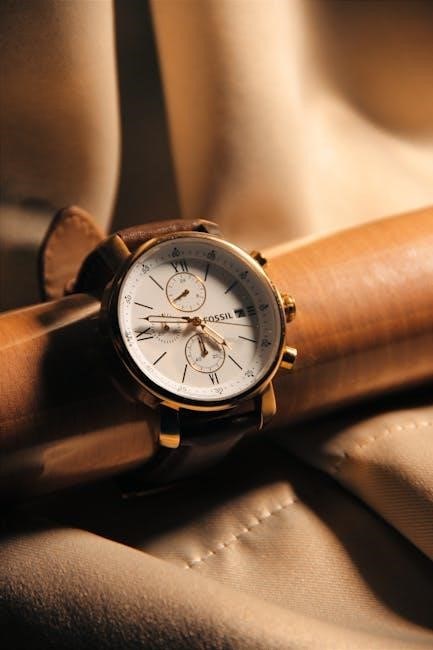
Interface Navigation: Utilize the touchscreen, rotating bezel (if equipped), and side buttons to navigate the interface. Customize watch faces and apps within the Fossil app for a personalized experience.
Downloading the Fossil App
Essential First Step: To unlock the full potential of your Fossil smartwatch, downloading the Fossil app is crucial. This application serves as the central hub for managing your device, customizing settings, and accessing various features.
Platform Availability: The Fossil app is readily available for both major mobile operating systems. iOS users can find it on the Apple App Store, while Android users can download it from the Google Play Store. Simply search for “Fossil” within the respective app store.
Installation Process: Once located, tap the “Install” or “Get” button to begin the download and installation process. Ensure you have a stable internet connection for a smooth and quick download.
Pairing Your Smartwatch
Establishing Connection: After installing the Fossil app, open it and follow the on-screen prompts to begin the pairing process. Ensure your smartwatch is sufficiently charged and within Bluetooth range of your smartphone.
Bluetooth Activation: The app will request permission to enable Bluetooth on your smartphone. Grant this permission to allow the app to discover and connect to your Fossil smartwatch.
Device Selection: The app will scan for available devices. Select your specific Fossil smartwatch model from the list displayed. A pairing code may appear on both your phone and watch – confirm they match.
Finalizing Pairing: Confirm the pairing request on both devices. The app will then synchronize with your smartwatch, transferring essential data and settings.
Navigating the Smartwatch Interface
Touchscreen Controls: Your Fossil smartwatch utilizes a responsive touchscreen. Swipe left or right to cycle through tiles displaying information like activity tracking, heart rate, and notifications.
Button Functions: The side buttons offer quick access to key features. Typically, the top button launches the app list, while the bottom button often serves as a shortcut to customizable functions.
Tile Customization: Within the Fossil app, personalize your tile arrangement to prioritize the data most important to you. Add, remove, or rearrange tiles for a tailored experience.
Menu Access: Swipe down from the watch face to reveal quick settings like brightness and Do Not Disturb mode. Explore the settings menu for deeper customization options.